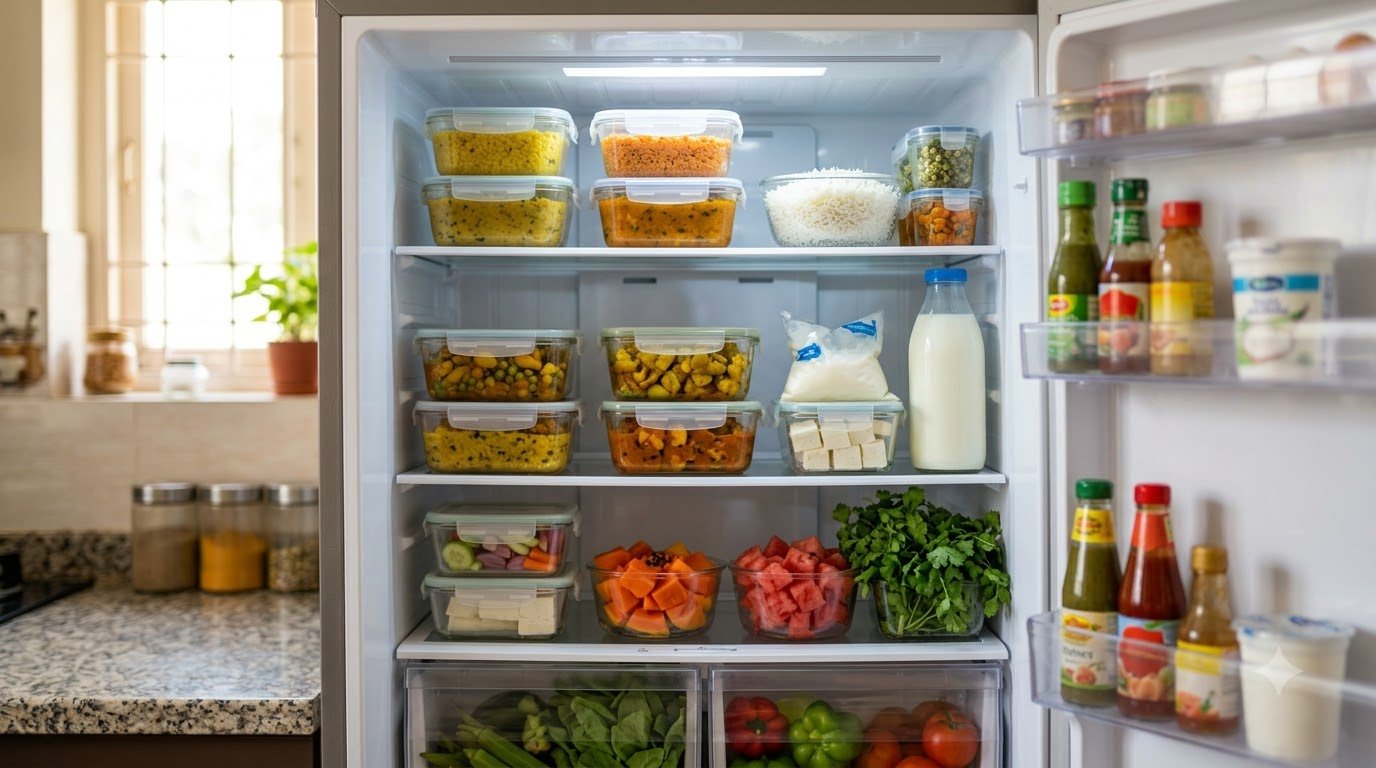
Almost every household uses a refrigerator to keep food fresh and safe. Whether it is leftover dal, rice, cooked vegetables, milk, or paneer, we often put food in the fridge assuming it will remain safe for several days.
But have you ever wondered, how long does food actually stay safe in the fridge?
Refrigeration does not keep food safe forever. Low temperatures slow the growth of many microorganisms, but they do not stop all food spoilage or eliminate every food-safety risk.
That is why understanding proper refrigeration and food storage is important.
In this complete Food Storage Guide, we will look at how to store cooked food, dal, rice, vegetables, milk, paneer, dough, fruits, and other everyday foods safely.
You can also explore more practical advice in our Food Tips and Kitchen Guide sections on Meenraz Cooking.
What Is the Correct Refrigerator Temperature?
The temperature of your refrigerator plays an important role in keeping perishable food safe.
According to the U.S. Food & Drug Administration (FDA), refrigerators should be kept at 40°F (4°C) or below, while the freezer should be kept at 0°F (-18°C).
If your refrigerator is not cold enough, food may become unsafe even when it still looks or smells normal.
Avoid overfilling the refrigerator as well. Cold air needs enough space to circulate around the food.
A refrigerator thermometer can be useful if you want to regularly check whether your appliance is maintaining a safe temperature.
How Long Does Food Last in the Fridge After Cooking?
One of the most common questions about food storage is how long cooked leftovers can be refrigerated.
According to the USDA Food Safety and Inspection Service, refrigerated leftovers should generally be used within 3 to 4 days.
If you do not plan to eat them within that period, freezing them earlier may be a better option.
However, this does not mean every food automatically becomes spoiled on the fourth day.
Food safety also depends on how the food was prepared, how quickly it was refrigerated, the refrigerator temperature, and how it was handled before storage.
How Long Can Dal and Cooked Vegetables Be Refrigerated?
Dal, curry, and cooked vegetables are everyday foods in many Indian households.
As a general rule for cooked leftovers, they should usually be consumed within 3–4 days when properly refrigerated.
Always store cooked food in clean and covered food-safe containers.
If you notice visible mould, an unusual smell, unexpected colour changes, or other obvious signs of spoilage, discard the food.
Looking for ideas for your next meal? Explore our Dal Recipes and Sabzi Recipes on Meenraz Cooking.
How Should You Store Cooked Rice?
Cooked rice should not be left at room temperature for an unnecessarily long period.
Perishable foods and leftovers should generally be refrigerated within 2 hours. If the surrounding temperature is above approximately 90°F (32°C), this period drops to around 1 hour, according to food-safety guidance from the FDA.
Transfer leftover rice into a clean container and refrigerate it promptly.
As part of the general leftovers rule, properly refrigerated cooked rice should generally be used within 3–4 days.
Only remove the amount you need and return the remaining food to the refrigerator promptly.
You can also explore our Rice Recipes for more rice-based meal ideas.
How Long Can Milk Be Kept in the Refrigerator?
The storage life of milk varies depending on its processing method, packaging, storage conditions, and the manufacturer’s instructions.
For this reason, there is no single refrigerator-storage period that applies to every type of milk.
Always check the storage directions and use-by or expiry information printed on the package.
After using milk, return it to the refrigerator promptly instead of leaving it on the kitchen counter for a long period.
Also avoid storing milk in places where the temperature fluctuates significantly.
How Should Paneer Be Stored?
Paneer and other dairy products need proper refrigeration.
For packaged paneer, follow the manufacturer’s storage instructions and date information printed on the package.
Once opened, keeping paneer properly covered in a clean food-safe container can help protect it from contamination.
If the paneer develops an unusual smell, colour, texture, or other signs of spoilage, do not assume that cooking it will automatically make it safe.
How Should Kneaded Dough Be Stored?
Many Indian households prepare dough at night and keep it refrigerated for the following day.
If you refrigerate kneaded dough, avoid leaving it uncovered.
Place it in a clean, food-safe and properly covered container. This helps prevent the surface from drying out and reduces exposure to contaminants from other foods.
Whenever practical, preparing fresh dough according to your requirements is preferable to storing it for unnecessarily long periods.
For more practical kitchen advice, visit the Kitchen Tips section on Meenraz Cooking.
How Should Cut Fruits and Vegetables Be Stored?
Once fruits and vegetables have been peeled or cut, proper handling becomes even more important.
Refrigerate cut produce promptly and keep it in clean, covered containers.
The FDA’s guidance on safely handling fruits and vegetables also recommends keeping produce separate from raw meat, poultry, and seafood.
This separation helps reduce the risk of cross-contamination.
Use separate cutting boards or thoroughly clean preparation surfaces when switching between raw animal products and fresh produce.
Can You Put Warm Food Directly in the Refrigerator?
A common kitchen myth is that warm food should never be placed in the refrigerator.
Leaving a large quantity of perishable food at room temperature for several hours, however, is not a safer solution.
Large quantities of food can be divided into smaller, shallow containers so they cool more quickly.
Perishable food generally should not remain at room temperature for more than 2 hours, or approximately 1 hour when the temperature is above 90°F (32°C).
Prompt refrigeration is therefore more important than waiting several hours for a large pot of food to become completely cold.
The Right Way to Store Food in the Refrigerator
Use clean, covered containers when storing leftovers. Avoid leaving cooked food uncovered inside the refrigerator.
If you have prepared a large quantity, divide it into smaller or shallow containers. This allows food to cool more quickly.
Adding the storage date to containers can also make it easier to identify older leftovers.
Raw meat, poultry, seafood, and similar products should be kept separate from ready-to-eat food. Make sure their juices cannot drip onto other foods.
Can You Tell Whether Food Is Safe Just by Smelling It?
Many people smell leftover food before deciding whether it is safe to eat.
Smell and appearance can help identify obvious spoilage, but they should not be treated as reliable food-safety tests.
Some harmful microorganisms may be present without producing an obvious change in smell, taste, or appearance.
Therefore, if you do not know how long perishable food has been stored or how long it remained at an unsafe temperature, do not rely only on smell.
When the storage history is uncertain, food safety should come first.
How Long Does Refrigerator Food Stay Safe During a Power Cut?
This is particularly useful to know in places where power outages can occur.
According to the FDA’s food-safety guidance for power outages, an unopened refrigerator can generally keep food cold for about 4 hours during a power outage.
Keep the refrigerator door closed as much as possible.
Opening it repeatedly allows cold air to escape and causes the internal temperature to rise more quickly.
After a long power outage, the actual temperature of the food and how long it remained above safe refrigeration temperatures become important factors when deciding what to keep.
Food Storage Quick Guide
| Food | General Refrigerator Guidance |
|---|---|
| Cooked leftovers | 3–4 days |
| Dal/Curry | Generally 3–4 days |
| Cooked vegetables | Generally 3–4 days |
| Cooked rice | Generally 3–4 days |
| Soup/Stew | 3–4 days |
| Milk | Follow package and manufacturer instructions |
| Packaged paneer | Follow package storage instructions |
| Cut fruits/vegetables | Refrigerate promptly and monitor for spoilage |
Important: These are general food-safety guidelines. Actual storage time can vary depending on freshness, preparation, handling, packaging, and refrigerator temperature.
5 Important Rules for Storing Food in the Fridge
1. Keep your refrigerator at 4°C (40°F) or below. Maintaining the correct temperature is one of the most important parts of refrigerated food safety.
2. Refrigerate perishable foods promptly. Do not routinely leave them at room temperature for more than two hours.
3. Use clean, covered containers. Proper containers help protect food from contamination and prevent it from drying out.
4. Do not overcrowd your refrigerator. Cold air needs space to circulate effectively.
5. When in doubt, avoid unnecessary risk. If you do not know how a perishable food was stored or it shows signs of spoilage, discarding it may be the safer choice.
Conclusion
A refrigerator helps keep food fresh and safe for longer, but refrigerated food does not last forever.
As a general food-safety rule, cooked leftovers should usually be consumed within 3–4 days. Your refrigerator should also remain at 4°C (40°F) or below, and perishable foods should be refrigerated promptly.
Simple habits such as using clean containers, separating raw and cooked foods, dating leftovers, and maintaining the correct refrigerator temperature can improve food safety while also helping reduce unnecessary food waste.
Explore more Food Tips, Food Storage Guides, and Kitchen Tips on Meenraz Cooking for practical advice you can use in your kitchen every day.
If you found this Meenraz Cooking Food Storage Guide helpful, share it with your family and friends.
FAQs
How many days can cooked food stay in the fridge?
Most properly refrigerated cooked leftovers should generally be consumed within 3–4 days, according to USDA food-safety guidance.
Can I eat dal after 5 days in the fridge?
The general USDA recommendation for refrigerated leftovers is 3–4 days. Food that has gone beyond this period should not be considered safe simply because it still smells normal.
What temperature should a refrigerator be?
The FDA recommends keeping the refrigerator at 40°F (4°C) or below and the freezer at 0°F (-18°C).
Can warm food be placed in the refrigerator?
Yes. Large amounts should ideally be divided into smaller, shallow containers so they cool more quickly. Perishable food should not be left at room temperature for several hours while waiting for it to become completely cold.
Does reheating make spoiled food safe?
No. Reheating should not be used as a way to make food safe when its storage history is questionable or it has already spoiled.
How long can refrigerator food stay safe during a power outage?
According to the FDA, an unopened refrigerator can generally keep food cold for approximately 4 hours during a power outage.



Join the conversation